battlestation
Only one bezel from the chair
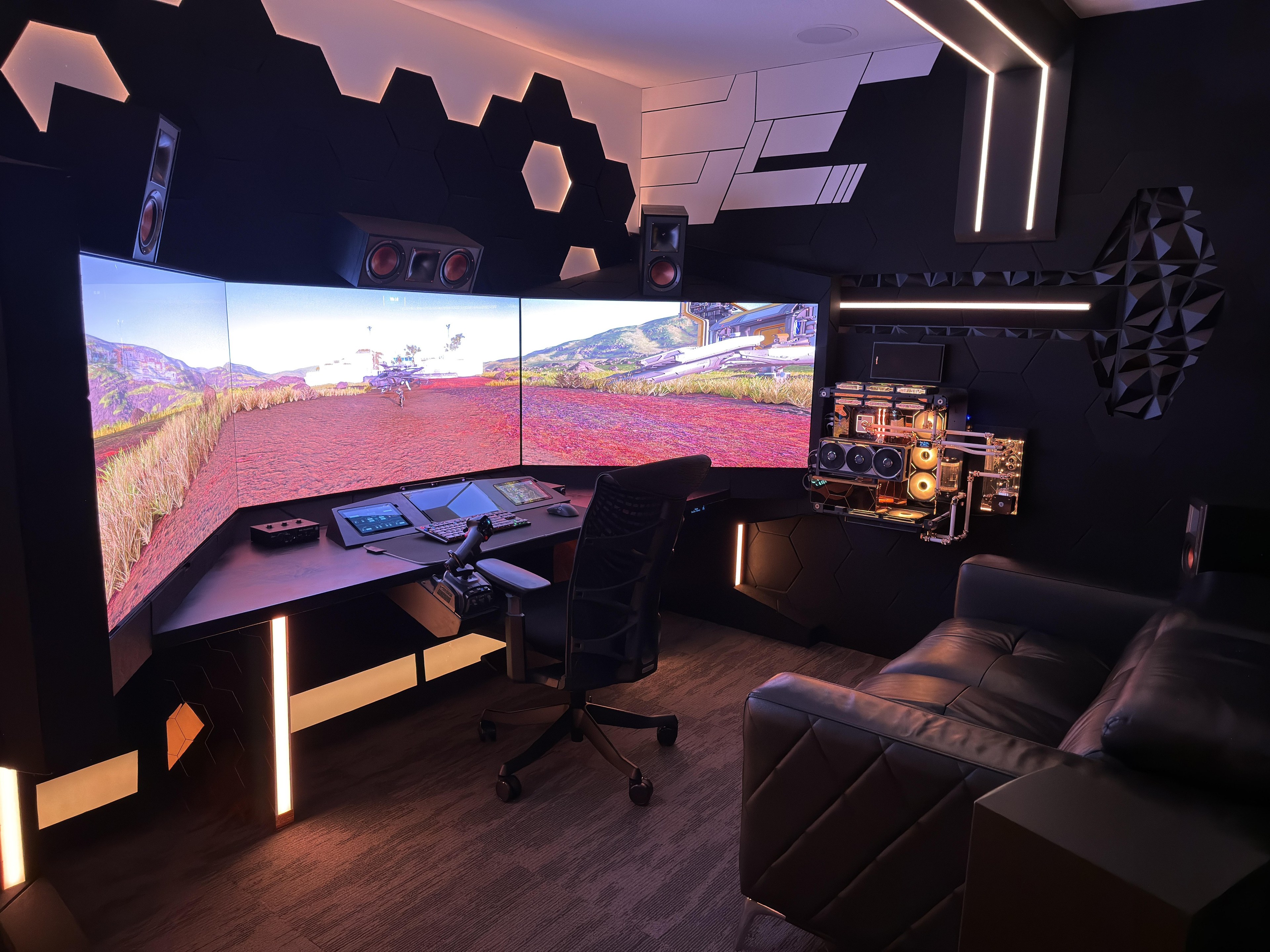
Three 55 inch OLEDs stand in an arc over a plywood desk, in a basement room finished in black. The computer hangs open on the wall beside them.
The room went up over three years, in the basement. Everything in it is black. Hexagon panels cover the wall behind the screens, angular ones run down the right-hand side, and lit channels follow the ceiling, the walls and the underside of the desk. The dark surfaces keep reflections off the screens. The panels are there for the sound as well: two subwoofers shake the living room above, and the panels hold the vibration down.
Three 55 inch Samsung S90D OLEDs stand in an arc, on brackets fixed to a frame of two-by-fours. The outer two overlap the middle one a little, so from the chair only one bezel width shows. An enclosure around them tilts the speakers above the screens down towards the chair. Star Citizen will fill all three at 11520 by 2160, which takes it from about 160 frames a second at 4K down to about 80. Most other games run at 7680 by 2160 with frame generation on.
The desk is plywood, stained black, and it was cut down from the old one to meet the base of the three screens. Three small screens sit flush in the top: a fourteen inch touch display in the middle, and an Amazon Fire HD 8 on either side for the multi-function displays in Star Citizen. Fitting each one and routing a channel for its cable was the slowest part of the whole build.
The computer hangs open on the wall to the right, a Thermaltake Core P6 on brackets. Two D5 pumps feed one loop and each runs at half speed. The loop turns a lot of corners, which costs flow, so two pumps still push two and a half litres a minute, and either one can fail. The graphics card keeps its own air cooler, because putting it under water would end the warranty.
The chair is an Autonomous ErgoChair Ultra V2, bought for a bad back after one that always leaned to one side. Its armrests move in every direction, so it fits between the two joystick supports. A phone app runs most of the lighting. The strips carry seventy-four lights a metre and sit in deep channels behind frosted covers, which is what stops the hot spots showing.
products
- AMD Ryzen 7 9800X3DProcessor
- ASUS ROG Crosshair X670E HeroMotherboard
- Asus ROG Strix XG349CIn an alcove to the left of the outer screen. It was the main screen once, and now it sets up the ROG Ally for travelling.Display
- Audioengine S8An eight inch subwoofer.Speakers
- Barrow flow meterMonitoring
- Corsair Hydro X XR5 240mm radiatorCooling
- Corsair Hydro X XR5 360mm radiator×2Cooling
- Denon AVR-X4800HRuns a 7.2.4 Dolby Atmos layout, ceiling speakers included.Audio interface
- EK Quantum Convection D5 pump cover×2Cooling
- G.Skill Trident Z5 Royal Neo DDR5 64GB CL26CL26, the lowest latency DDR5 on sale, and it has run well with the 9800X3D.Memory
- JBL Quantum OneHeadphones
- Klipsch R-100SWA ten inch subwoofer. It and the other one shake the living room above, which is why the walls carry panels.Speakers
- Lian Li EG1200G1200 watts, gold rated.Power supply
- Meta Quest 3Accessory
- ModDIY custom cablesWhite, for the graphics card and the board.Cable management
- Moza R3A wheel and pedal set for WRC and F1 24, not plugged in at the moment.Controller
- Samsung 970 Pro 1TBStorage
- Samsung 990 Pro 2TB×2Storage
a part earns a pin when the source names the product